The complete guide to choosing your bamboo pendant light
Choosing a bamboo pendant is not only a question of light; it is a decorative decision that can change the character of an entire room. A woven shade is an object by day and an atmosphere by night, which means it has to work twice. Here is what actually matters, in the order it matters.
Why choose bamboo
Bamboo combines things that rarely come together: it is light enough to hang from a standard ceiling fixture, strong enough to hold a wide sculptural shape without a heavy frame, and warm enough in tone to flatter almost any palette. Woven, it diffuses light instead of blocking it — you get a glow and a pattern rather than a hard pool.
It is also genuinely sustainable. Bamboo regrows in under five years without replanting, and a raw, unvarnished shade is fully biodegradable at the end of a very long life.
Getting the size right
Match the shade to the surface
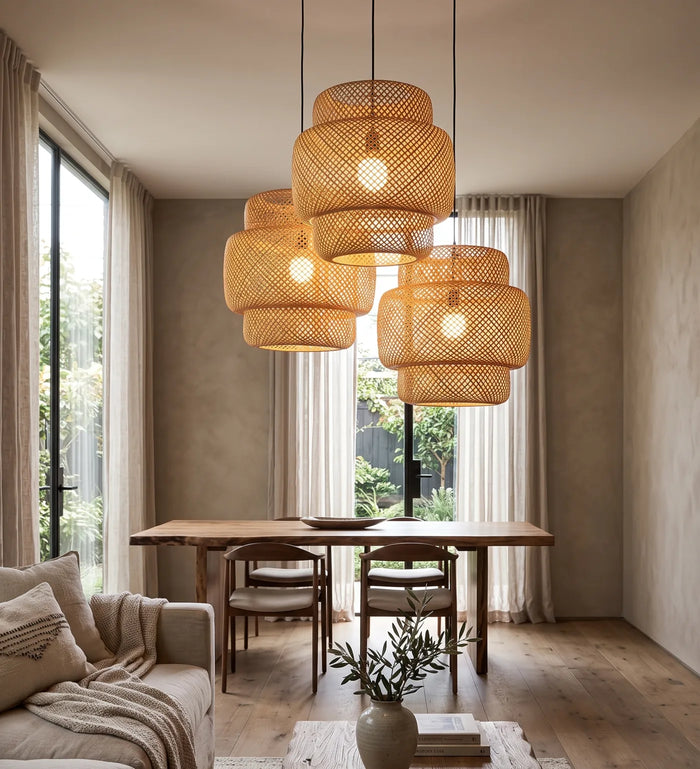
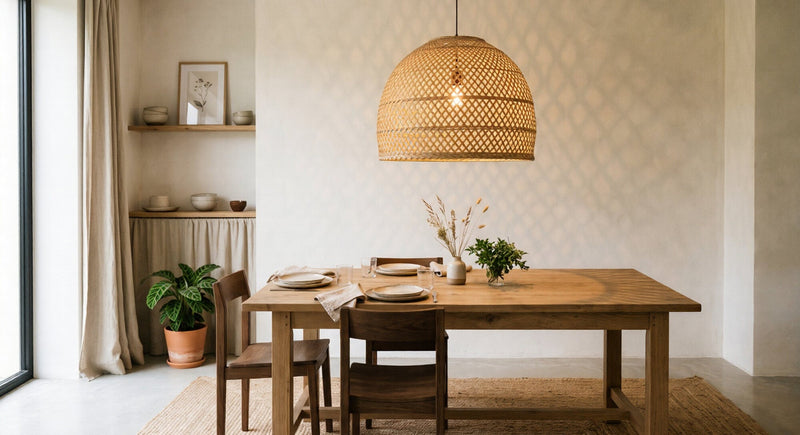
Over a dining table, a shade should be roughly half to two-thirds the width of the table. Narrower than that and it looks stranded; wider and people knock their heads standing up. For a 120 cm table, 60 to 80 cm of shade is the sweet spot.
Match it to the room too
A rough rule for a shade hung in open space: add the room's length and width in metres, and use that number in centimetres as a maximum diameter. A 4 m by 3 m room tolerates a shade up to about 70 cm.
Height above the table
75 to 90 cm between the tabletop and the bottom of the shade. Lower feels intimate and is usually the better mistake; higher loses the shadow play that makes a woven shade worth having.
Reading the weave
Open versus dense
An open weave throws pattern onto ceilings and walls and gives a room drama. A denser weave keeps the light contained and softer. Dining rooms and entryways suit open; bedrooms and reading corners suit dense.
Bamboo or rattan
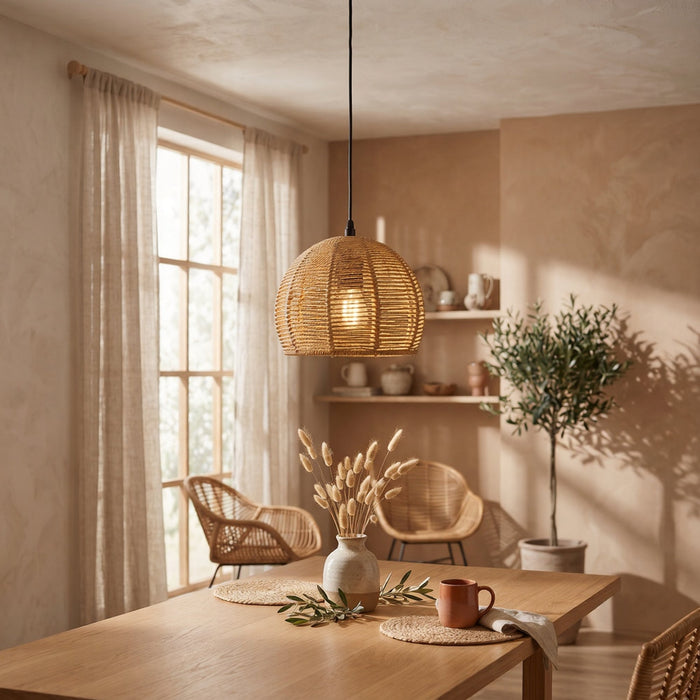
They are often confused. Bamboo is hollow and split into flat, glossy strips — the weave comes out fine, regular and slightly reflective. Rattan is a solid vine used as round strands, giving a thicker, matte, more rustic texture. Neither is better, but they light very differently: bamboo sparkles, rattan absorbs.
Signs of real handwork
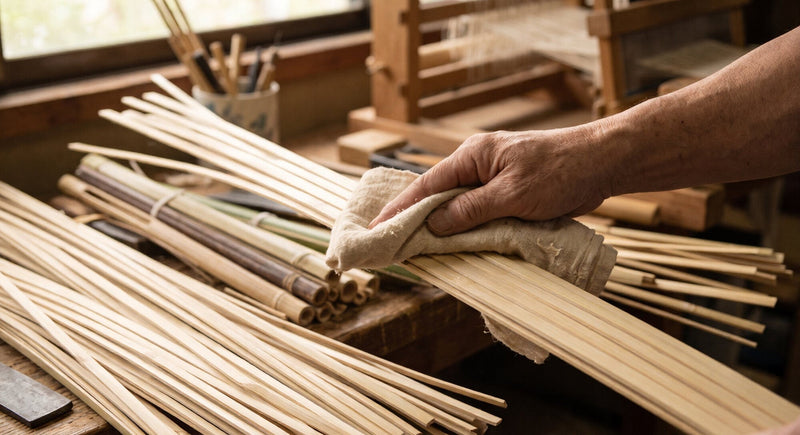
Look for small irregularities in the weave and a shade that is numbered or batched. Perfect uniformity usually means a mould and a machine.
The technical details people forget
Bulb and colour temperature
Use 2700K warm white, always. Cooler light turns bamboo grey. LED is strongly preferable to halogen: it stays cool, which protects the fibre, and it lasts long enough that you rarely need to reach into the shade.
Dimming
A dimmable bulb on a dimmer switch doubles what a woven shade can do — bright and graphic for dinner, low and amber afterwards. It is the cheapest upgrade available.
Cord, canopy and ceiling
Check the cord length against your ceiling height before you order, and confirm the fitting matches your socket (E27 is the European standard). Woven shades are light, so almost any existing ceiling box will take one.
A last word on choosing
The pendant you will still like in ten years is usually the one with a shape you can describe in a single word. Trends live in detail; longevity lives in silhouette. Pick the form first, then check the numbers.
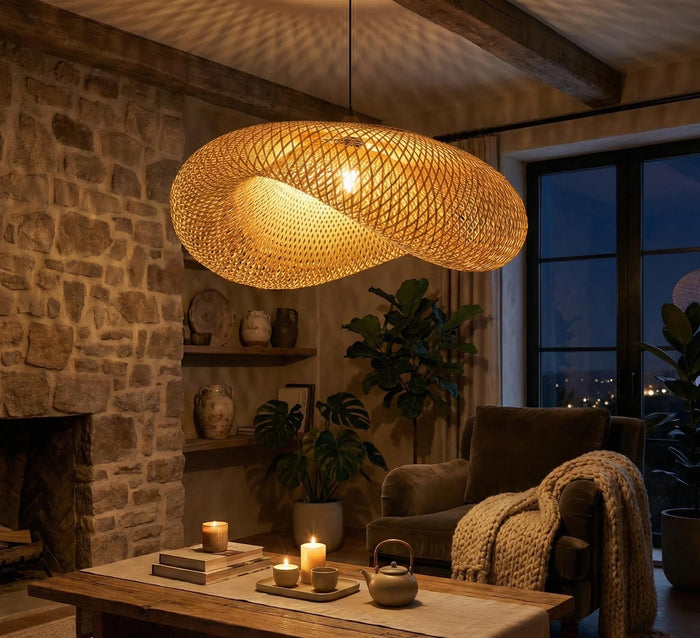
Our signature Bamboo Wave Pendant comes in three sizes, woven by hand in small batches: see the collection.